BioMaterialities
  • Project
    • Work Packages
    • Scientific Advisory Board
    • Cooperating Partners
  • Team
  • Publications
  • Events
    • Recordings
  • English
    • Deutsch
pexels.com
Publications

Louisa Prause / Sarah Hackfort / Margit Lindgren (2020) Digitalization and the third food regime

by BioMat October 16, 2020

Abstract: This article asks how the application of digital technologies is changing the organization of the agri-food system in the context of the third food regime. The academic debate on digitalization and food largely focuses on the input and farm level. Yet, based on the analysis of 280 digital services and products, we show that digital technologies are now being used along the entire food commodity chain. We argue that digital technologies in the third food regime serve on the one hand as a continuation of established information and communication technologies, thus deepening certain features of the existing food regime such as the retail sector’s control over global commodity chains. On the other hand, digital technologies also introduce new forms of control and value extraction based on the use of data and pave the way for large tech companies to take over market shares in the agri-food sector. Finally, we find that multinational agri-food companies are starting to take on the business models of leading digital tech companies, for instance by developing digital platforms throughout the agri-food system. We argue that this shows that the broader economic restructuring of neoliberal capitalism towards digital capitalism is also making its way into the agri-food system.

Zusammenfassung: In diesem Artikel wird gefragt, wie die Anwendung digitaler Technologien die Organisation des Agrar- und Lebensmittelsystems im Kontext des dritten food regimes verändert. Die akademische Debatte über Digitalisierung und Ernährung konzentriert sich hauptsächlich auf die Input- und Farmebene. Basierend auf der Analyse von 280 digitalen Diensten und Produkten zeigen wir, dass digitale Technologien jetzt entlang der gesamten Lebensmittelkette eingesetzt werden. Wir argumentieren, dass digitale Technologien im dritten food regime einerseits als Fortsetzung etablierter Informations- und Kommunikationstechnologien dienen und damit bestimmte Merkmale des bestehenden Lebensmittelregimes wie die Kontrolle des Einzelhandelssektors über globale Warenketten vertiefen. Andererseits führen digitale Technologien auch neue Formen der Kontrolle und Wertschöpfung auf der Grundlage von Daten ein und ebnen großen Technologieunternehmen den Weg, Marktanteile im Agrar- und Ernährungssektor zu übernehmen. Schließlich stellen wir fest, dass multinationale Agrar- und Lebensmittelunternehmen beginnen, die Geschäftsmodelle führender Digital-Tech-Unternehmen zu übernehmen, indem sie beispielsweise digitale Plattformen im gesamten Agrar- und Lebensmittelsystem entwickeln. Wir argumentieren, dass dies zeigt, dass die breitere wirtschaftliche Umstrukturierung des neoliberalen Kapitalismus hin zum digitalen Kapitalismus auch Eingang in das Agrar- und Ernährungssystem findet.

Citation: Prause, Louisa; Hackfort, Sarah and Lindgren, Margit (2020): Digitalization and the third food regime. Agriculture and Human Values.

DOI: https://doi.org/10.1007/s10460-020-10161-2

[source of picture: pexels.com]
October 16, 2020 0 comment
Publications

Louisa Prause and Philippe Le Billon (2020): Struggles for land: comparing resistance movements against agro-industrial and mining investment projects

by BioMat August 24, 2020

Abstract: Investments in large-scale land-based projects increased over the past two decades, with a concomitant rise in community-level resistance. Drawing from data on resistance movements, literature findings, and two case studies in Senegal, this paper compares movements resisting either agro-industrial or mining projects. Building on contentious politics and materialist approaches from political ecology we find that outcomes seem largely case-dependent and determined by political opportunities, while resistance motives, narratives and more confrontational practices differ across both sectors. We suggest that this can be explained through sector-specific material, discursive and institutional factors. Our findings shed light on challenges for cross-sectoral alliances.

Citation: Prause, Louise and Le Billon, Philippe (2020): Struggles for land: Comparing resistance movements against agro-industrial and mining investment projects. The Journal of Peasant Studies, DOI: 10.1080/03066150.2020.1762181.

Link: https://www.tandfonline.com/doi/full/10.1080/03066150.2020.1762181


[source of picture: pexels.com]

August 24, 2020 0 comment
Publications

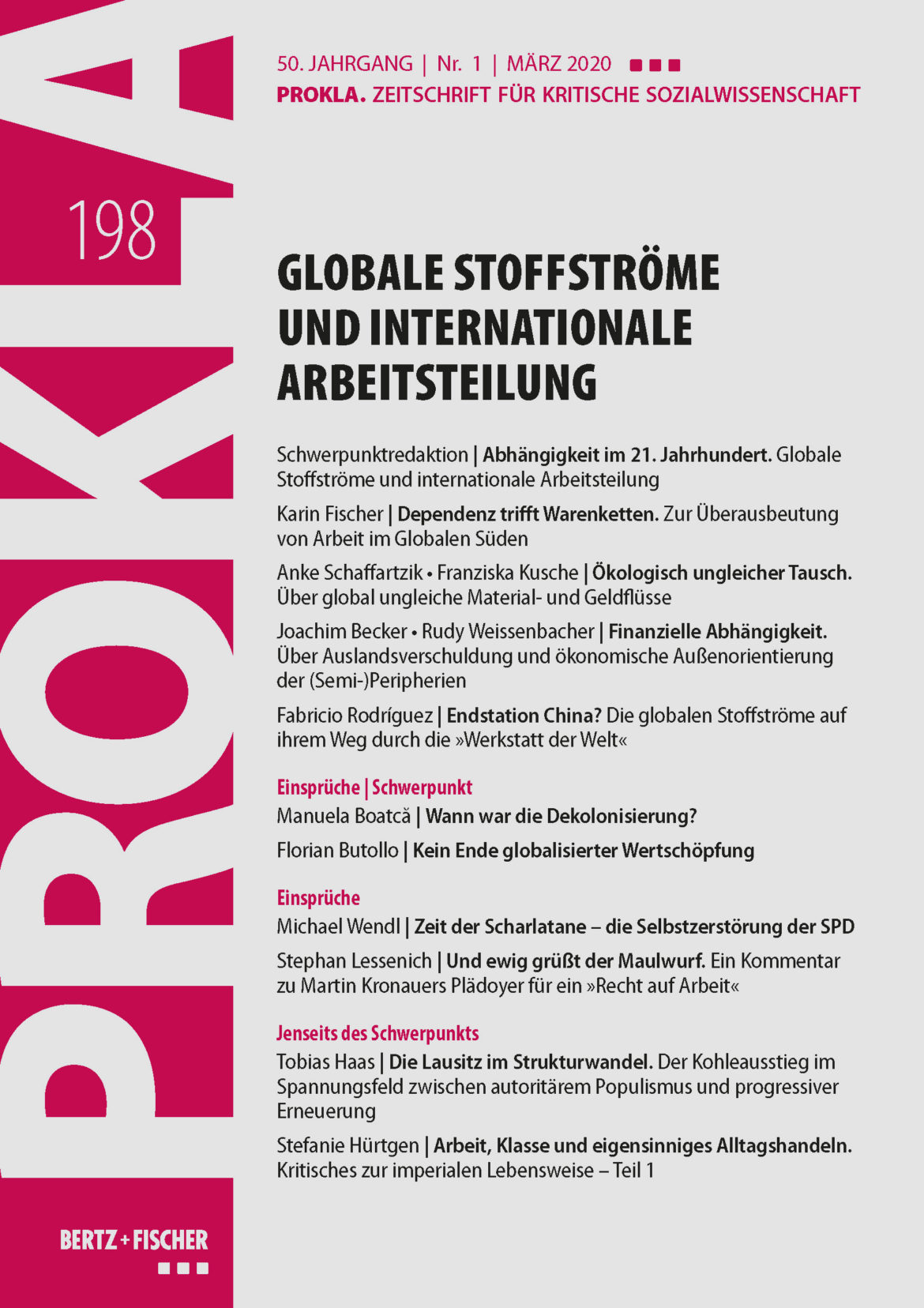
Anke Schaffartzik / Franziska Kusche (2020): Ökologisch ungleicher Tausch

by BioMat April 16, 2020

Abstract: International ecological inequality is a precondition for the growth-led ‘development’ currently unfolding at the global level with disastrous environmental and social impacts. As ecologically unequal exchange, international trade leads to the constriction of the ecological operating space of some while expanding that operating space for others. This not only allows for further growth but also exacerbates already existing ecological inequalities and asymmetrical power relations.

Zusammenfassung: Die wachstumsgeleitete ‚Entwicklung‘, die derzeit trotz verheerender ökologischer und sozialer Konsequenzen verfolgt wird, ist abhängig von ökologischer Ungleichheit. Als ökologisch ungleicher Tausch erlaubt der Außenhandel die Ausdehnung des ökologischen Handlungsspielraums einiger weniger, während er für viele andere deren Einengung bedeutet. Das erst ermöglicht weiteres globales Wachstum und verschärft dabei gleichzeitig bestehende Ungleichheiten und asymmetrische Machtverhältnisse.

Citation: Schaffartzik, Anke und Kusche, Franziska (2020): Ökologisch ungleicher Tausch. Wachstum auf Kosten von Mensch und Natur: Nur ungleiche Material- und Geldflüsse in globalem Maßstab ermöglichen eine wachstumsorientierte Entwicklung. PROKLA. Zeitschrift für Kritische Sozialwissenschaft, 50 (198), 53-67.

DOI: https://doi.org/10.32387/prokla.v50i198.1854

[Bildquelle: https://www.bertz-fischer.de/IMG/jpg/bertz_fischer_prokla_198_globale_stoffstrome_300dpi_rgb.jpg]

April 16, 2020 0 comment
Publications

Sarah Hackfort / Daniela Gottschlich (2019): Green Economy

by BioMat March 10, 2020

Abstract: Im Jahr 2005 erschien das »ABC der Globalisierung«. Inzwischen zeigen sich die Auswirkungen der neoliberalen Globalisierung in aller Deutlichkeit: Aus dem Wohlfahrtsversprechen ist eine Welt der globalen (Un)Ordnung geworden. 114 Autorinnen und Autoren greifen in 126 Stichwörtern die aktuellen Entwicklungen auf, erarbeiten politische Orientierungspunkte und zeigen Alternativen. Auch für das neue Standardwerk der Globalisierungskritik gilt: »Eine andere Welt ist möglich«

Citation: Sarah Hackfort/ Daniela Gottschlich (2019): Green Economy, in: Claudia von Braunmühl/Heide Gerstenberger/Ralf Ptak/Christa Wichterich (Hrsg.) ABC der globalen (Un)Ordnung. Von »Anthropozän« bis »Zivilgesellschaft«. VSA Verlag, S. 110-111.

[Bildquelle: © vsa-verlag]


Leseprobe:

https://www.vsa-verlag.de/uploads/media/www.vsa-verlag.de-ABC-der-globalen-_Un_Ordnung.pdf


March 10, 2020 0 comment
Publications

Miriam Boyer (2019): Alternativen zum Extraktivismus oder alternative Extraktivismen?

by BioMat March 10, 2020

Abstract: Extraktivismus und das mit ihm verbundene Wirtschaftsmodell, besonders in den Staaten Lateinamerikas, war von Beginn an Thema der Arbeit der Kollegforscher_innengruppe Postwachstumsgesellschaften. Ein Entwicklungsmodell, das seit einigen Jahrzehnten wieder verstärkt auf Rohstoffabbau und -export setzt, bot Anlass für eine Auseinandersetzung mit unterschiedlichen Wachstumsstrategien und -modellen im Globalen Süden. Der vorliegende Band, herausgegeben von Martín Ramírez und Stefan Schmalz, nimmt diese oft als »Neoextraktivismus« bezeichnete Entwicklung nach dem »Linksruck« in Lateinamerika genauer in den Blick und beleuchtet die Spannungen, Widersprüche und Widerstände entsprechender Strategien. Anschaulich analysieren die Autorinnen und Autorendes Bandes die Auswirkungen unterschiedlicher extraktivistischer Wirtschaftszweige wie Bergbau, Wasser- und Forstwirtschaft, Erdölgewinnung und monokulturelles Agrobusiness in verschiedenen südamerikanischen Ländern. Sie zeichnen die Konflikte, die in den betroffenen Regionen entstehen, präzise nach. Darüber hinaus widmen sich die Beitragenden be- und entstehenden oder bisher nur imaginierten Alternativen zum Extraktivismus. Auf diese Weise öffnen sie Denkhorizonte für postextraktivistische Produktions- und Lebensweisen.

Citation: Miriam Boyer (2019): Alternativen zum Extraktivismus oder alternative Extraktivismen? »Grüne« Strategien und der Streit um die Kontrolle natürlicher Ressourcen, in: Martín Ramírez, Stefan Schmalz (Hrsg.) Extraktivismus – Lateinamerika nach dem Ende des Rohstoffbooms. Oekom Verlag, S.177-192.

[Bildquelle: © oekom]


Leseprobe:

https://www.oekom.de/_files_media/titel/leseproben/9783962381516.pdf

March 10, 2020 0 comment
Publications

Beate Friedrich / Sarah Hackfort / Miriam Boyer / Daniela Gottschlich (2019): Conflicts over GMO and their Contribution to Food Democracy

by AdminBioMat December 23, 2019

Abstract: The use of genetically modified organisms (GMOs) embodies a specific vision of agricultural systems that is highly controversial. The article focuses on how conflicts over GMOs contribute towards food democracy. Food democracy is defined as the possibility for all social groups to participate in, negotiate and struggle over how societies organize agricultural production, thereby ensuring that food systems fulfil the needs of people and sustain (re)productive nature into the future. EU agricultural policy envisages the coexistence of agricultural and food systems with and without GMOs. This policy, which on the surface appears to be a means of avoiding conflict, has in fact exacerbated conflict, while creating obstacles to the development of food democracy. By contrast, empirical analysis of movements against GMOs in Germany and Poland shows how they create pathways towards participation in the food system and the creation of alternative agricultural futures, thereby contributing to a democratization of food systems and thus of society–nature relations. Today, as products of new breeding techniques such as genome editing are being released, these movements are gaining new relevance.

Citation: Beate Friedrich; Sarah Hackfort; Miriam Boyer; Daniela Gottschlich (2019): Conflicts over GMO and their Contribution to Food Democracy, in: Politics and Governance Vol. 7, No 4 (2019), S. 165-177.

DOI: http://dx.doi.org/10.17645/pag.v7i4.2082


Full Text
https://www.cogitatiopress.com/politicsandgovernance/article/view/2082/2082

December 23, 2019 0 comment
Load More Posts

Recent Posts

  • On the social implications of technological processes: Towards hybrid social life cycle analysis (H-SLCA)

    February 20, 2026
  • The political economy of carbon farming: Analyzing agribusiness’ accumulation strategy and the imaginary of soil carbon markets

    July 1, 2025
  • “Non-extractivist” extractivism: The valorization process of voluntary soil carbon schemes

    June 12, 2025
  • High-tech guardians for the rainforest? How activists in Latin America are taking action against environmental crimes

    February 12, 2025

Events

There are no events

BIOMATERIALITIES – Agricultural and Food Policy Group, Department of Agricultural Economics, Faculty of Life Sciences, Humboldt-Universität zu Berlin, Germany

  • Legal Notice
  • Privacy Policy
  • Contact

@2019 | BioMaterialities

BioMaterialities
  • Project
    • Work Packages
    • Scientific Advisory Board
    • Cooperating Partners
  • Team
  • Publications
  • Events
    • Recordings
  • English
    • Deutsch