BioMaterialities
  • Project
    • Work Packages
    • Scientific Advisory Board
    • Cooperating Partners
  • Team
  • Publications
  • Events
    • Recordings
  • English
    • Deutsch
Category:

Events

Events

Sarah Hackfort: Chair of Conference Panel “Unravelling the Political Ecology of Technologies and Digitalisation in the Agri-food System”

by BioMat May 24, 2024

Sarah Hackfort will chair the panel “Unravelling the Political Ecology of Technologies and Digitalization in the Agri-food System” at the POLLEN24 conference in Lund, Sweden.

Panel Description

Over the past decades, a convergence of multiple crises, including the 2007/08 food crisis and other socio-ecological crises, brought to the surface awareness of the fragility of the global food system and raised concerns regarding future access to food and its availability to feed the world’s growing population without exacerbating the negative
environmental impacts of current food production. New farming techniques, developed along the lines of technological innovations and the digitalisation of agriculture, currently occupy a growing place in the agriculture field. Described by some as the fourth agricultural revolution, these techniques are being promoted by a variety of actors as a solution to feed a growing global population with less (as well as more precise) and thus more sustainable use of inputs.

While some attention has been given to the digitalisation of agriculture in social science research including science and technology studies and critical food studies, the scholarship has so far given limited attention to the intersection between the material and discursive practices around technology, digitalisation, and innovation, and its intersection with the policies and discourses on environmental politics. Particularly lacking are historical studies on the digitalisation of agriculture, and whether or not this “revolution” and its environmental impacts are different from previous ones (such as the Green Revolution or the industrialisation of agriculture).

In this panel, we want to put forward the important insights that can be gained from adopting a political ecology perspective in addressing technological innovations and the digitalisation of agriculture, topics that have so far rarely been addressed from a political ecology perspective. We aim to bring together conceptual and empirical contributions from a variety of geographical areas. We invite abstract submissions that analyse the materiality and narratives of technological innovations and the digitalisation of agriculture as they relate to environmental politics, as well as historical analyses on these topics.

Program


The conference schedule can be viewed here.

Header image generated using openai.com

May 24, 2024 0 comment
Events

Miriam Boyer and Sarah Hackfort: Conference Presentation “Technology concepts in ecological economics: A lens for understanding digital technologies and green growth”

by BioMat May 24, 2024

Miriam Boyer and Sarah Hackfort will give a presentation on “Technology concepts in ecological economics: A lens for understanding digital technologies and green growth” at the ESEE Degrowth Conference in Pontevedra, Spain.

Abstract

In this contribution, we seek to gain conceptual clarity regarding technologies from the perspective of ecological economics. Our motivation for this inquiry is a lack of conceptual definitions of technology within the field ecological economics: While many authors in the field certainly identify a role for technology, such as a tool for reducing material throughput in society; or a role in finding substitutes for particular materials, a concept of technology, is largely missing. This is a surprising omission, due to the key role that technologies play in shaping societies’ how societies interact with nature. Inspired by concepts from the field of ecological economics, we suggest some building blocks for such a concept of technology. This includes technology as mediator of “the relationship between ecosystems and economic systems in the broadest sense” (Costanza, 1989). Moreover, given ecological economics’ attention to materiality— including the material components of society, economic activity in terms of biophysical flows corresponding to and reflecting societal relations of power, production, culture, etc.— we end up with a concept of technology that encourages us to think of particular technologies in terms how they define the relationship between society and nature in its material dimensions. Based on these conceptual building blocks, we offer some insights into a particular technological relationship: digital technologies and green economies. This relationship is explored in a Special Feature on the materiality of digital technologies in green economic contexts.


Program


The conference program can be viewed here.

Header image generated using openai.com

May 24, 2024 0 comment
Events

Public Lecture: Challenges in proving climate mitigation with carbon farming measures

by BioMat April 10, 2024

Challenges in proving climate mitigation with carbon farming measures

Soils store large amount of carbon and can act as carbon sinks. However, not all measures to enhance soil carbon results in carbon sinks and not all carbon sinks result in negative emissions or climate change mitigation. Carbon farming is a promise to farmers and society to elevate the potential of soils to reverse greenhouse gas emissions. The pitfalls and challenges in achieving this goal will be presented and discussed in this talk  by Prof. Dr. Axel Don (Thünen-Institut) from a soil scientist’s perspective.

Recording


Header image generated using openai.com

April 10, 2024 0 comment
Events

Workshop: Sustainability, Technologies, and Digitalization – Critical Social Science Perspectives

by BioMat January 31, 2024

Workshop: Sustainability, Technologies, and Digitalization – Critical Social Science Perspectives

This workshop aims to foster discussion on how critical social science research can explore the
emergence and deployment of digital and other technologies and unpack their social and political
impacts and implications in the context of the grand sustainability challenges. The workshop will
serve as a platform for scholars from diverse backgrounds to engage in meaningful
interdisciplinary exchange and contribute to research on societal and sustainability transformation.
Topics will focus (but not be limited to) technologies in sustainability transformations in agri-food
and energy systems. We invite participants to present their current research and encourage critical
discussion and feedback. We also aim to encourage participants to identify common interests and
generate ideas for potential collaborative projects, such as publications or research proposals.

Organizers: Prof. Dr. Silke Beck (TUM); Dr. Sarah Hackfort (HU Berlin)

Participation


Online participation is possible via Zoom – please contact: Sarah Hackfort, sarah.hackfort@hu-berlin.de


Header image generated using openai.com.

January 31, 2024 0 comment
Events

Public Lecture: Racial capitalism in Canada. Lessons for the environmental justice movement?

by BioMat January 5, 2024

Racial capitalism in Canada. Lessons for the environmental justice movement?

Drawing from his monograph in preparation, Interlocking Racisms: Multiple Colonialisms, Accumulated Violence, and Degrowth Plenitude, Sourayan Mookerjea interrogates the limits and possibilities of climate and environmental justice mobilization around the slogan of a green new deal in Canada. Despite this movement’s enthusiasm for the cultural politics of Indigenous Resurgence and its rhetorical support for decolonization, Indigenous land based sovereignty organizations keep themselves at a distance from its conventional statist political imaginary. Moreover, a northern-centred, climate emergency panicked imaginary seems to be losing popular momentum in a conjuncture marked by green passive revolution and fascism redux. This is taking place both nationally and transnationally while new formations of interlocking racisms enable the advance of class projects from above. Sourayan Mookerjea examines the crisis prone fault lines of this emergent conjuncture in Canadian society historically. He foregrounds the Canadian state’s articulation through interlocking neocolonial systems of oppression and argues for the importance of molecular social revolution against toxic cultures of empire now weaponized on replay.

Recording


Header image generated using openai.com

January 5, 2024 0 comment
Events

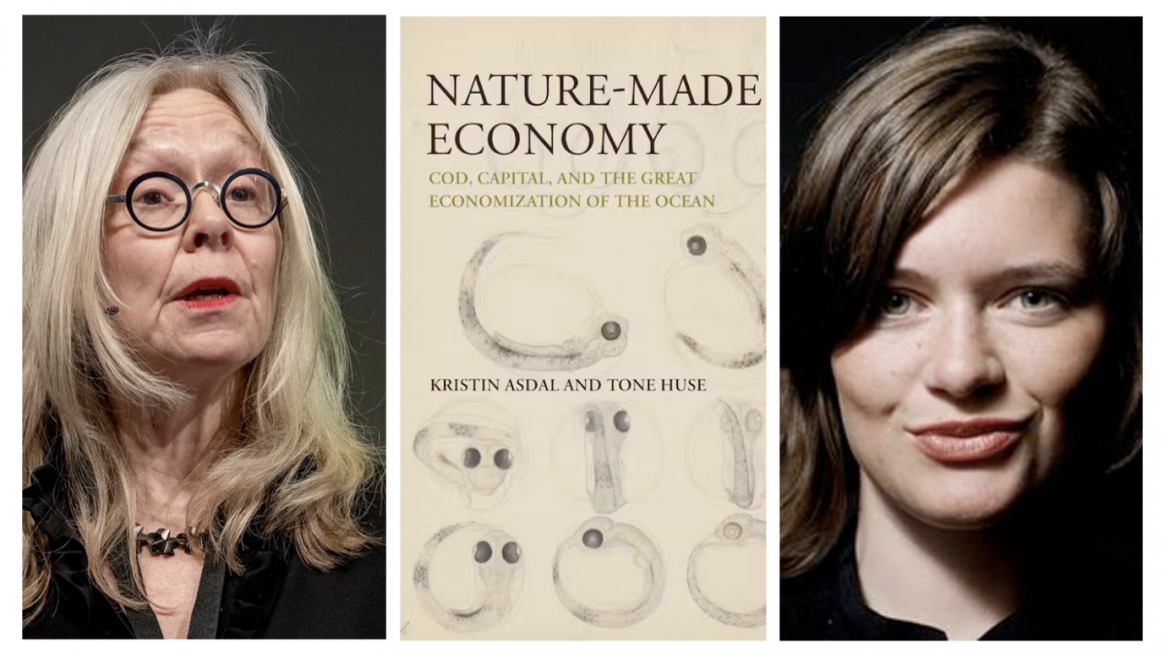
Public Lecture: Nature-Made Economy: Cod, Capital, and the Great Economization of the Ocean

by BioMat January 2, 2024

Nature-Made Economy: Cod, Capital, and the Great Economization of the Ocean

The ocean is the site of an ongoing transformation that is aimed at creating new economic opportunities and prosperity. In Nature-Made Economy, Kristin Asdal and Tone Huse explore how the ocean has been harnessed to become a space of capital investment and innovation, and how living nature is wrested into the economy even as nature, in turn, resists, adapts to, or changes the economy. The authors’ innovative methodological and conceptual approaches examine the economy by focusing on surprising and numerous “little tools”—such as maps and policy documents, quality patrols, and dietary requirements for the enhancement of species’ biological propensities—that value, direct, reorder, accomplish, and sometimes fail to serve our ends, but also add up to great change.

Throughout Nature-Made Economy, Asdal and Huse follow one species, the Atlantic cod, and explore how it is subjected to different versions of economization. Taking this species as a point of departure, they then provide novel analyses of the innovation economy, the architecture of markets, the settling of prices, and more, revealing how the ocean is rendered a space of intense economic exploitation. Through their analysis, the authors develop a distinct theoretical approach and conceptual vocabulary for studying nature–economy relations.

Nature-Made Economy is a significant contribution to the broad field of STS and social studies of markets, as well as to studies of the Anthropocene, the environment, and human–animal relations.

After a presentation of the book by one of the authors, Kristin Asdal, Cornelius Heimstädt will moderate the discussion.

This event is part of the public lecture series ‘High-Tech Valorization of Nature: (Re)Production, Technology and Politics in Green Capitalist Projects’ hosted by the BioMaterialities Research Group at Humboldt University Berlin.

Recording


Book


The book has been published open access and can be read here.


January 2, 2024 0 comment
Events

Sarah Hackfort: “Untangling the digital in food system transformations”

by BioMat September 11, 2023

On August 30, 2023, Sarah Hackfort gave a presentation at the event “Democratization through digitalization? Exploring emancipatory agricultural technologies”, at the panel: “Untangling the digital in food system transformations”, at the Royal Geographical Society (with IBG) Annual International Conference 2023 in London, United Kingdom.

September 11, 2023 0 comment
Events

Sarah Hackfort: “Unpacking the Social Implications of Digital Transformation in Agri-Food Systems for Sustainability”

by BioMat September 6, 2023
On September 7, 2023, Sarah Hackfort will give the presentation “Unpacking the Social Implications of Digital Transformation in Agri-Food Systems for Sustainability” as a contribution to the ECPR panel “Sustainability transitions and inequality”.

View schedule


September 6, 2023 0 comment
Events

Sarah Hackfort: “Sustainability and Democracy in the Digital Transformation of the Agri-food System. On the Contributions of a Feminist Care Perspective”

by BioMat September 6, 2023
Am 5.September 2023 hielt Sarah Hackfort den Vortrag “Sustainability and Democracy in the Digital Transformation of the Agri-food System. On the Contributions of a Feminist Care Perspective” als einen Beitrag zum Panel “The Green and the Digital: Environmental Political Thought Encounters “the Fourth Industrial Revolution” der ECPR.

View schedule

September 6, 2023 0 comment
Events

Sarah Hackfort and Miriam Boyer: “The Making of Sustainability: Political Consent for the Bioeconomy in Germany”

by BioMat September 6, 2023

On September 4, 2023, Miriam Boyer and Sarah Hackfort presented the paper “The Making of Sustainability: Political Consent for the Bioeconomy in Germany” as a contribution to the ECPR panel “Critical Approaches to Bioeconomy Politics and Policy”.

Abstract

Based on the increased use of biomass, the bioeconomy is presented by its proponents as renewable and therefore sustainable. However, academic and non-academic actors have strongly questioned this sustainability, citing the negative socio-ecological aspects of biomass use. Given this contradiction, we look at German bioeconomy policy and ask how key institutions of the innovation system (government, science, and industry), construct and uphold the image of sustainability of biomass use in the bioeconomy. Through an analysis based on Gramscian analysis of political consent, this paper looks at biomass policy in Germany. The paper identifies four ideological strategies to uphold the image of sustainability and contribute to creating political consent for the political project of the German bioeconomy: seeking managerial solutions, relying on technological innovation, relegating solutions into the future, and obscuring the materiality of nature. The paper discusses how these strategies are upheld by the wider discourse and institutions of ecological modernization and argues that particular attention should be given to the biophysical materiality of living nature in this context. The materiality of nature represents both an obstacle to the ideological strategies identified, and a starting point for envisioning alternative society–nature relations.


View schedule

Access article

September 6, 2023 0 comment
  • 1
  • 2
  • 3
  • 4
  • 5
  • …
  • 8

Recent Posts

  • On the social implications of technological processes: Towards hybrid social life cycle analysis (H-SLCA)

    February 20, 2026
  • The political economy of carbon farming: Analyzing agribusiness’ accumulation strategy and the imaginary of soil carbon markets

    July 1, 2025
  • “Non-extractivist” extractivism: The valorization process of voluntary soil carbon schemes

    June 12, 2025
  • High-tech guardians for the rainforest? How activists in Latin America are taking action against environmental crimes

    February 12, 2025

Events

There are no events

BIOMATERIALITIES – Agricultural and Food Policy Group, Department of Agricultural Economics, Faculty of Life Sciences, Humboldt-Universität zu Berlin, Germany

  • Legal Notice
  • Privacy Policy
  • Contact

@2019 | BioMaterialities

BioMaterialities
  • Project
    • Work Packages
    • Scientific Advisory Board
    • Cooperating Partners
  • Team
  • Publications
  • Events
    • Recordings
  • English
    • Deutsch