BioMaterialities
  • Projekt
    • Arbeitspakete
    • Wissenschaftlicher Beirat
    • Kooperationspartner
  • Team
  • Publikationen
  • Veranstaltungen
    • Aufzeichnungen
  • Deutsch
    • English
Category:

Publications-de

Publications-de

Algorithmic expert services: When expert values meet scalability thinking (pre-print)

by BioMat September 26, 2024

Cornelius Heimstädt und Maximilian Heimstädt haben einen Preprint ihres Artikels „Algorithmic Expert Services: When Expert Values Meet Scalability Thinking“ veröffentlicht. Der finale Artikel erscheint im Frühjahr 2025 in einer Special Issue des Journals Research in the Sociology of Organizations zum Thema „Expertise in Research in the Sociology of Organizations.“

Den Preprint finden Sie unter folgendem Link: https://osf.io/preprints/socarxiv/2s56x.

September 26, 2024 0 comment
Publications-de

Feminist Perspectives on the Bioeconomy

by BioMat Mai 7, 2024

Feminist Perspectives on the Bioeconomy

Sarah Hackfort und Anna Saave haben zusammen mit Carlotta Brinkmann von der Universität Erfurt einen Blogeintrag zu Feministischen Perspektiven auf die Bioökonomie auf econ4future.org veröffentlicht.

Blogeintrag lesen


Der Blogeintrag kann hier gelesen werden:

Lesen


Header image generated using openai.org.

Mai 7, 2024 0 comment
Publications-de

Democratization through precision technologies? Unveiling power, participation, and property rights in the agricultural bioeconomy

by BioMat März 23, 2024

Sarah Hackfort published an article in Frontiers in Political Science.

Abstract

This piece addresses the political dimension of sustainability in the agricultural bioeconomy by focusing on power, participation, and property rights around key technologies. Bioeconomy policies aim to establish economic systems based on renewable resources such as plants and microorganisms to reduce dependence on fossil resources. To achieve this, they rely on economic growth and increased biomass production through high-tech innovations. This direction has sparked important critique of the environmental and social sustainability of such projects. However, little attention has been paid in the bioeconomy literature to the political dimension surrounding key precision technologies such as data-driven precision agriculture (PA) or precision breeding technologies using new genomic techniques (NGT). The political dimension includes questions of power, participation, and property rights regarding these technologies and the distribution of the benefits and burdens they generate. This lack of attention is particularly pertinent given the recurring and promising claims that precision technologies not only enhance environmental sustainability, but also contribute to the democratization of food and biomass production. This contribution addresses this claim in asking whether we can really speak of a democratization of the agricultural bioeconomy through these precision technologies. Drawing on (own) empirical research and historical evidence, it concludes that current patterns are neither driving nor indicative of a democratization. On the contrary, corporate control, unequal access, distribution, and property rights over data and patents point to few gains for small firms and breeders, but to a reproduction of farmers’ dependencies, and less transparency for consumers.?

Read Article


The paper has been published open access and can be read online.

Read Article

Cite as

Hackfort, S. (2024). Democratization through precision technologies? Unveiling power, participation, and property rights in the agricultural bioeconomy. Frontiers in Political Science, 6, 1363044. https://doi.org/10.3389/fpos.2024.1363044


Header image generated using openai.com.

März 23, 2024 0 comment
Publications-de

Harvesting value: Corporate strategies of data assetization in agriculture and their socio-ecological implications

by BioMat März 14, 2024

Sarah Hackfort co-authored an article with Sarah Marquis and Kelly Bronson in Big Data & Society.

Abstract

The global food system is characterized by market concentration and oligopoly. In our article, we focus on the most powerful input supply and machinery companies and analyze how these firms create value, both economic and otherwise, from big data. In digital capitalism, data is valorized across sectors; personal data is aggregated into large-scale datasets, a practice that feeds economic concentration and monopolization. Big data also has become central to the business model for agricultural companies; it is a claim made by the companies themselves. Yet, little is known about their specific strategies to do so. We aim to fill this gap, asking how is agricultural data transformed into value by the most powerful agribusinesses and ag-tech firms?

Through the lens of assetization, we examine corporate strategies for transforming agricultural data into value. We draw on literature from food studies, specifically political economic analyses of the historical practices of agricultural corporations, as well as literature from critical data studies that investigates data as an asset. For our analysis, we rely on a variety of gray literature and public-facing documents: financial documents, sustainability and shareholder reports, terms of use, license agreements, and news articles. Our results contribute to the critical data studies literature on agricultural big data by identifying three main strategies of assetization: securing relationships and dependence, price-setting and data sharing, and product development and targeted marketing.

The strategies have socio-ecological implications; our results indicate the reproduction of asymmetrical power relations in the agri-food system favoring corporations and the continuation of long-standing dynamics of inequalities.

Read Article


The paper has been published open access and can be read online.

Read Article

Cite as

Hackfort, S., Marquis, S., & Bronson, K. (2024). Harvesting value: Corporate strategies of data assetization in agriculture and their socio-ecological implications. Big Data & Society, 11(1). https://doi.org/10.1177/20539517241234279

Blog Post


A blog post summarising the article’s key findings was published here.

Read Blog Post


Header image generated using openai.com.

März 14, 2024 0 comment
Publications-de

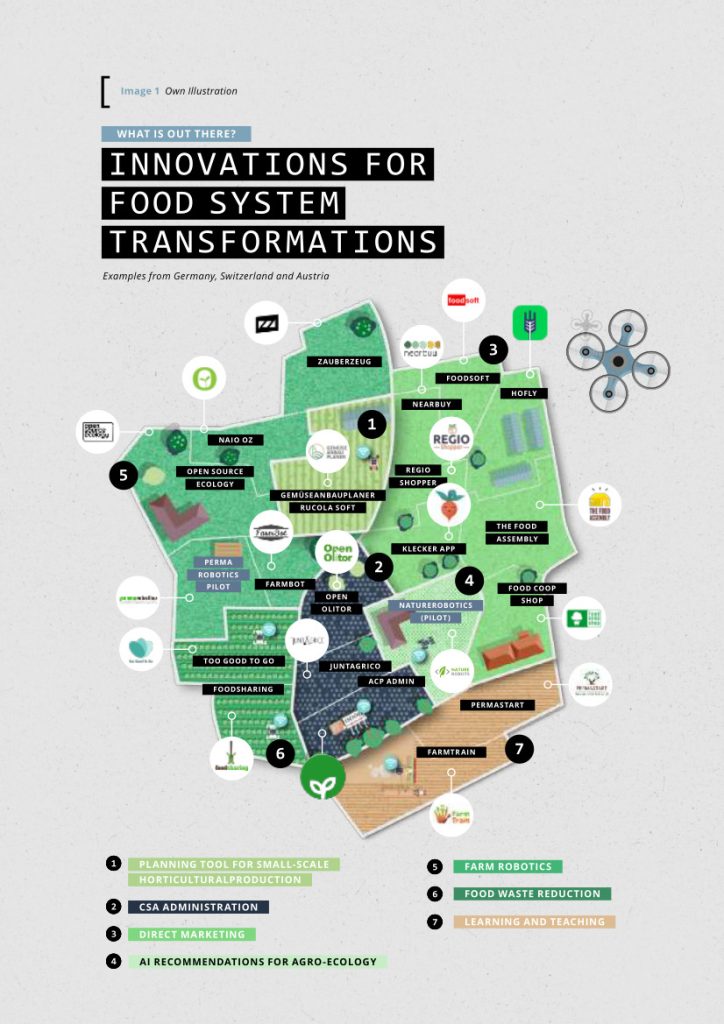
Louisa Prause et al.: „Digitale Technologien für eine sozial-ökologische Transformation der Landwirtschaft“

by BioMat November 5, 2023

Abstract

Wie können digitale Technologien zur Agrarwende beitragen? Viele digitale Werkzeuge der vierten landwirtschaftlichen Revolution werden von großen Agrar-Chemie- und Agrar-Maschinen-Konzernen entwickelt, die auf die Optimierung des agrarindustriellen Produktionsmodells abzielen. Es gibt jedoch Alternativen. TechEntwickler erarbeiten gemeinsam mit kleinbäuerlichen Produzenten und zivilgesellschaftlichen Initiativen neue digitale Produkte, die eine kleinteilige, diverse, solidarische und lokale Nahrungsmittelversorgung unterstützen.


Artikel lesen

English version

Cite as

Prause, Louisa, and Alwin Egger. “Digitale Technologien für eine sozial-ökologische Transformation der Landwirtschaft.” Berlin, 2023.

(Header image created using openai.com)

November 5, 2023 0 comment
Publications-de

Anna Saave et al.: “Why are feminist perspectives, analyses, and actions vital to degrowth?”

by BioMat Oktober 17, 2023

Abstract

Feminist analyses of the historical dynamics of gender systems are fundamental to the work of challenging growth-driven political economies, and of designing more equitable and balanced ecosocial systems. Feminist theories and methods that acknowledge and support diverse voices, knowledges, and practices are vital resources for building on heterodox degrowth movements. In dialogue with postcolonial, decolonial, indigenous, and anti-racist efforts, intersectional feminisms have been unlearning and disrupting conventional politics of knowing and action in ways that help forge more inclusive understandings and applications necessary for degrowth futures. With the purpose of highlighting advances on these three fronts, this essay was co-written by participants in the Feminisms and Degrowth Alliance (FaDA), an inclusive network of activists and scholars that has supported an array of collaborative initiatives. FaDA’s birthplace was the 5th International Conference on Degrowth in Budapest in 2016, where a surprisingly large turnout for the roundtable Degrowth and feminism(s): Conflicts, intersections, and convergences between two radical political movements motivated the establishment of the FaDA mailing list, our main means of communication. FaDA participation reflects the diversity of degrowth advocates in general: a 2017 survey (Iserlohn, 2018) revealed that members bring varying activist, academic, household, and professional experiences from wide-ranging contexts around the world. This essay is illuminated with examples from our own journeys toward more inclusive and mutual learning across languages, nationalities, cultures, gender identities, and time zones, all challenges engaged in the co-writing process. We celebrate the launching of the journal Degrowth as a convivial space for generating and exploring knowledge and practice from diverse perspectives. And we push the journal to realize its tremendous potential to foster synergies around feminisms and degrowth. The main part of this text explores powerful contributions from feminist thought and practice. We then identify a set of important issues and approaches advanced by feminisms and degrowth scholarship, and point to potential for further work along these lines. Our conclusions draw on histories of movement-building across diverse feminisms worldwide to strategize ways to strengthen degrowth alliances toward shared goals of emancipatory ecosocial transformation.

Read article

Cite as

“Why are feminist perspectives, analyses, and actions vital to degrowth?” (2023) Degrowth journal. Available at: https://degrowthjournal.org/publications/2023-05-03-why-are-feminist-perspectives-analyses-and-actions-vital-to-degrowth/.


Header image generated with openai.com

Oktober 17, 2023 0 comment
Publications-de

Sarah Hackfort: „Unlocking sustainability? The power of corporate lock-ins and how they shape digital agriculture in Germany“

by BioMat Juli 4, 2023

Sarah Hackfort veröffentlicht einen Artikel zum Thema „Unlocking sustainability? The power of corporate lock-ins and how they shape digital agriculture in Germany“ im Journal of Rural Studies.

Der Artikel wurde open access veröffentlicht.

Abstract
The digital transformation of agriculture is widely presented as a path to sustainability and a win-win strategy that benefits the environment, farmers, and consumers alike. However, recent studies show how the digital economy is characterized by monopolystructures, market concentration and corporate power that determine patterns of control over digital technology, distribution of benefits and value creation from data. In the field of agriculture, there is a lack of empirical research on lock-ins that examines in detail the logic of these effects, the actors, and the power dynamics behind them. Yet such insights are exactly what is needed to better understand the effects and to break unsustainable lock-ins towards more sustainable agri-food systems. Drawing on the literature on the political economy of food and agriculture, and on studies of innovation and sustainability transitions, this article aims to fill this research gap. Based on an empirical case study in Germany, it identifies systemic, technological, data, legal, soft, and discursive lock-ins that reinforce existing power relations and farmers‘ dependence on corporate agro-industrial farming models. It concludes that sustainable transformations in agriculture require a disruption of the identified lock-ins at multiple levels.

Zum Artikel

Cite as

Hackfort, S. (2023). Unlocking sustainability? The power of corporate lock-ins and how they shape digital agriculture in Germany. Journal of Rural Studies, 101, 103065. https://doi.org/10.1016/j.jrurstud.2023.103065

Juli 4, 2023 0 comment
Publications-de

Boyer, Kusche, Hackfort, Prause und Engelbrecht-Bock (2022): „The making of sustainability: ideological strategies, the materiality of nature, and biomass use in the bioeconomy“

by BioMat Januar 13, 2023

Miriam Boyer schreibt zusammen mit Franziska Kusche, Sarah Hackfort, Louisa Prause und Friederike Engelbrecht-Bock einen Zeitschriftenartikel zum Thema „The making of sustainability: ideological strategies, the materiality of nature, and biomass use in the bioeconomy“.


Link: https://link.springer.com/article/10.1007/s11625-022-01254-4

Citation: Boyer, Miriam, Franziska Kusche, Sarah Hackfort, Louisa Prause und Friederike Engelbrecht-Bock (2022): The making of sustainability: ideological strategies, the materiality of nature, and biomass use in the bioeconomy, in: Sustainability Science.


[Bildquelle: unsplash.com/Rafael Albornoz]

Januar 13, 2023 0 comment
Publications-de

Buchkapitel: Miriam Boyer and Sarah Hackfort (2022) Materialität der Natur

by BioMat Januar 13, 2023

Miriam Boyer schreibt mit Sarah Hackfort ein Buchkapitel zum Thema „Materialität der Natur“ im Handbuch „Handbuch Politische Ökologie. Theorien, Konflikte, Begriffe, Methoden“.


Link: https://www.transcript-verlag.de/978-3-8376-5627-5/handbuch-politische-oekologie/

Citation: Boyer, Miriam, Sarah Hackfort (2022): „Materialität der Natur.“ In Daniela Gottschlich, Sarah Hackfort, Tobias Schmitt und Uta von Winterfeld, ed., Handbuch Politische Ökologie. Theorien, Konflikte, Begriffe, Methoden. transcript, Bielefeld.


[source of picture: unsplash.com/Adam Kool]

Januar 13, 2023 0 comment
Publications-deUncategorized

Buchkapitel: Miriam Boyer (2022) Biodiversität

by BioMat Januar 13, 2023

Miriam Boyer schreibt ein Buchkapitel zum Thema Biodiversität im Handbuch „Handbuch Politische Ökologie. Theorien, Konflikte, Begriffe, Methoden“.


Link: https://www.transcript-verlag.de/978-3-8376-5627-5/handbuch-politische-oekologie/

Citation: Boyer, Miriam (2022): „Biodiversität.“ In Daniela Gottschlich, Sarah Hackfort, Tobias Schmitt und Uta von Winterfeld, ed., Handbuch Politische Ökologie. Theorien, Konflikte, Begriffe, Methoden. transcript, Bielefeld.


[source of picture: unsplash.com/Henry Perks]

Januar 13, 2023 0 comment
  • 1
  • 2
  • 3
  • 4
  • 5

Recent Posts

  • On the social implications of technological processes: Towards hybrid social life cycle analysis (H-SLCA)

    Februar 20, 2026
  • The political economy of carbon farming: Analyzing agribusiness‘ accumulation strategy and the imaginary of soil carbon markets

    Juli 1, 2025
  • “Non-extractivist” extractivism:The valorization process of voluntary soil carbon schemes

    Juni 12, 2025
  • Hightech-Wächter für den Regenwald? Wie Aktivisten in Lateinamerika gegen Umweltverbrechen vorgehen

    Februar 12, 2025

Events

There are no events

BIOMATERIALITIES – Agricultural and Food Policy Group, Department of Agricultural Economics, Faculty of Life Sciences, Humboldt-Universität zu Berlin, Germany

  • Haftungsbeschränkung
  • Datenschutzbestimmung
  • Kontakt

@2019 | BioMaterialities

BioMaterialities
  • Projekt
    • Arbeitspakete
    • Wissenschaftlicher Beirat
    • Kooperationspartner
  • Team
  • Publikationen
  • Veranstaltungen
    • Aufzeichnungen
  • Deutsch
    • English